
The Post-Labor Prophecy: How Aristotle Predicted the Rise of AI and Why It Leads to an Age of Human Flourishing
How Aristotle Predicted the Rise of AI and Why It Leads to an Age of Human Flourishing

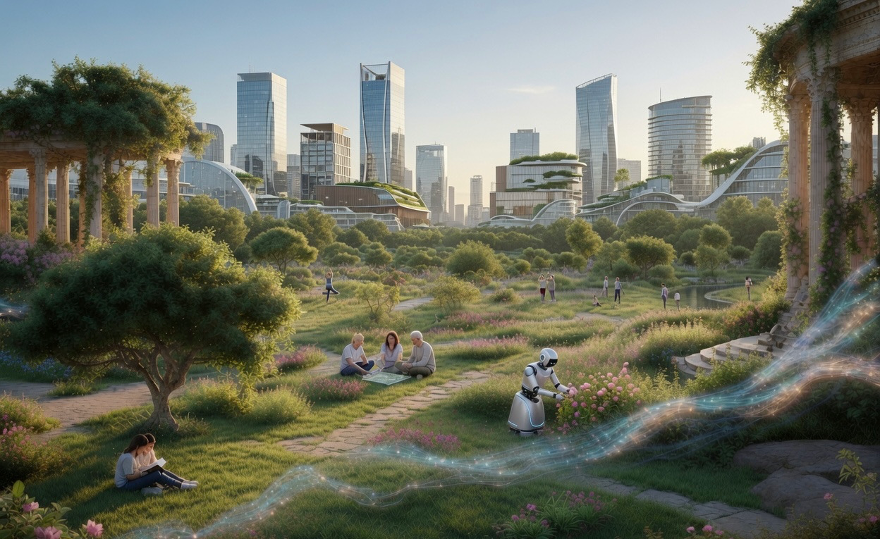
Around 350 BCE, Aristotle paused a dry passage on household management to imagine the impossible. He wrote, “Suppose that if every tool could do its own work on command, that the weaver’s shuttle could weave on its own and the quills played harps themself…then the master craftsman would have no need of assistants, and master no need of slaves.” Twenty-three centuries before the first transistor, he had described autonomous robots and the end of forced human labor.
The prediction was never the gift. The gift was the question Aristotle asked next, the one we are still dodging. If the machines do the work, what is a human life actually for? We are not ready for that answer, because too many of us have quietly collapsed our entire identity into our jobs. We are our title. We are our output. So machines that produce more, faster, and cheaper do not feel like liberation. They feel like erasure.
But production is not what makes us human. A robot will out-produce us all. What makes us human is the part the assembly line never measured: the dignity of being, and the ability to feel and give love. Somewhere along the way, capitalism stopped being a tool and quietly became our religion, with the Protestant work ethic as its catechism, the story we told ourselves to justify pushing billions into labor they knew was meaningless. Work is virtue, idleness is sin, your value is your productivity. It was a useful creed for an age of scarcity. It is a destructive one for the age now arriving.
We have a once-in-a-civilization chance to outgrow it, and we should not waste it by clutching the old creed so tightly that it drags us back toward a new feudalism, where a few own the machines and everyone else competes for scraps of purpose. But to seize that chance, we first have to understand what all of this technology is freeing us for, and not merely what it is freeing us from. And for that, it helps to return to the thinker who imagined this very moment more than two thousand years before it arrived.
What Aristotle actually saw?
Aristotle did not picture his automated future as idleness. Work was always a means; the end was eudaimonia, a word we mistranslate as happiness. It means flourishing: the active exercise of our highest capacities, in line with virtue, across a whole life. And it requires what he called schole, genuine leisure, not the couch and the feed but the free time in which a person genuinely thinks, creates, governs, befriends, and grows. We are unleisurely, he wrote, in order to have leisure. Toil was the entry fee. Flourishing was the point.
He drew one more line that matters enormously now. He split poiesis (job), the making of things for an end outside themselves, from praxis (the doing), action that carries its purpose within: thinking, creating, governing, caring for a community. Poiesis is what we do in order to live. Praxis is the living itself. Here is the quiet revelation of the AI transition. Machines automate poiesis. They do not, and largely cannot, automate praxis. They are coming for the means, not the ends. What they free is exactly the part of us that was never about output, which is the democratization of schole: the highest human luxury, once the privilege of a leisured few, that may now be turned into a birthright for all.
Aristotle could imagine this for everyone but never deliver it, because in his world the leisure of the few was paid for by the labor of slaves. Athenian flourishing sat on a brutal foundation. That is what makes this moment extraordinary. Advanced AI and robots are the automatic servants he imagined, except no one is enslaved to provide them. Technology becomes the engine of universal emancipation rather than its enemy, shifting the burden of toil off conscious beings and onto silicon and steel. For the first time, the flourishing once reserved for an elite can become the inheritance of everyone alive. We can finally realize an abundance envisioned 2,375 years ago. The next question is how will that change us?
The wave is real, even where the water looks calm
Before we turn to that question of meaning, though, it is worth pausing on a more immediate and entirely fair objection. If the machines are so capable, where are the missing jobs? Most offices look much as they did three years ago. That calm is the most misleading data in the debate. In The Enterprise AI Playbook, a Stanford Digital Economy Lab study I wrote with Elisa Pereira and Erik Brynjolfsson, across fifty-one successful AI deployments in eight countries, the same models produced change measured in weeks at some firms and years at others. The difference was never the technology. It was always the organization. More than three-quarters of the hardest obstacles were invisible and human: change management, data quality, and process redesign. General purpose technologies, like AI, have always taken significant time to deploy broadly into society as they require significant change in work flows to show their benefits. Thus it’s adoption shape is often called a J-curve.
The evidence lag is real, but it is a deployment lag, not a capability ceiling. Today’s systems can already perform most of the tasks in many white-collar roles, and firms rebuilt around agentic AI report median productivity gains north of 70 percent. Stanford’s Canaries in the Coal Mine study already finds early-career workers in exposed roles losing ground, and the World Bank estimates more than 60 percent of US jobs are exposed. The last three industrial revolutions took roughly 80, 60, and 40 years to unfold. This one could compress into five to ten. We just need to slow down AI for a bit (globally) to let society and the economy catch up, so it doesn’t break. Humanity has proven to be highly adaptable, but we need time. And in the big picture, if AGI arrives in 2 years or 10, it doesn’t matter much. But if AGI brings massive societal disruption, it matters a lot. It’ll take some international coordination to make it happen, but both the US and China have now expressed interest in collaborating on AI governance frameworks, at least around safety.
Why it will not feel like liberation?
The disruption is real, and it is arriving faster than our institutions are prepared for. You might assume that being freed from labor would land as pure relief. Ask people what happens when the machines take the jobs and you rarely hear relief. You hear dread, and that dread is the most important clue we have. Max Weber saw why a century ago. The Protestant ethic made labor a sacred duty and accumulation a sign of grace; the theology faded but the compulsion hardened into what he called an iron cage. We rank our worth by our output long after forgetting why. His verdict on the people inside it still stings: specialists without spirit, sensualists without heart. The cage is no longer around us. It is inside us. Which is why simply removing the need to work will not, by itself, free anyone.
The evidence is blunt. Lottery winners drift back to their old baseline within a year or two; the hedonic treadmill resets us to neutral after almost any gain. The Easterlin paradox shows the same across whole societies: above a threshold of security, more income barely moves life satisfaction. Material abundance has a ceiling, and the rich world is already pressed against it. More stuff was never going to save us.
What a human life is for
Eudaimonia is a verb, not a mood: you enact it, you cannot buy it. Modern science agrees. Self-Determination Theory, the most validated framework in motivation research, finds three innate needs: autonomy, the freedom to author your own life; competence, the drive to master things that matter; and relatedness, the need to be connected to and needed by others. None of the three requires money, scarcity, or a job. If neither a paycheck nor a pile of possessions can grant any of them, then where does a good life actually come from?
There is one more ingredient, and Homer saw it three thousand years ago. In the Odyssey, the nymph Calypso offers Odysseus the perfect post-scarcity life: immortality, safety, endless ease. And he weeps. Not from pain, but because on her island nothing depends on him. No one needs his return, no fragile web of obligation makes his choices matter. As I argue in my essay on Homer’s sirens and nymphs, Calypso’s trap is not pleasure. It is the loss of stakes. A human life can quietly end, without any violence, when it becomes fully solved and gently relieved of the need to choose. The deepest danger of abundance is not that we will have too much. It is that we will stop becoming.
Homer also handed us the remedy. Odysseus does not survive the Sirens through willpower; he has himself bound to the mast, choosing a constraint in advance to protect the self he wants to remain. I call it the Mast Principle and it inverts a modern assumption: the opposite of freedom is not constraint, it is drift. In a world saturated with frictionless ease, the people who flourish will be the ones who bind themselves to commitments that outlast their moods, to a craft, a cause, a community, a person who depends on them. Abundance can remove the chains of necessity. It cannot, and must not, remove the stakes.
Four fallacies we have to bury
If autonomy, mastery, connection, and stakes are what a flourishing life actually needs, why do we still find it so hard to believe that a life without forced labor could be a good one? Four old beliefs stand between us and that future. Each made sense under scarcity. Each is now a trap, and each is worth naming plainly.
Work is the source of our value. It never was. Work was the source of our survival, which we confused with worth. A nurse who retires is not worth less, and a child who has never held a job is not worth nothing. Dignity is intrinsic to being human, not a wage we earn through output. This is the first axiom of Abundanism: work is no longer the source of value, dignity is. Untether the two, and the fear of obsolescence loses its grip.
Leisure breeds laziness. This misreads both. Schole was the most active state of all, and biology agrees: the brain rewards pursuit and mastery for their own sake. Give people a real floor and most do not melt into the couch. They garden, build, coach, study, make music, and start new things. Idleness is what happens to caged animals, and to people whose every waking hour was already sold to someone else.
Meaning must be earned through suffering. This is the most seductive fallacy, because hardship can ennoble. But the suffering was never the point. We do not need misery to feel alive. We need a life that still demands something of us even when no one can force it. Keep the chosen difficulty that gives an achievement its weight, and let go of the pointless pain we dressed up in the language of virtue.
The rich and powerful will never share, so why bother seeking change. History and arithmetic disagree. I run the full numbers in The AGI Windfall Mirage, but one belongs here. Erica Chenoweth’s 3.5% rule finds that no modern government has survived a sustained, nonviolent movement that mobilized more than three and a half percent of its people. In the United States that is roughly twelve million, and AI’s displacement is on track to alienate far more. The historian Walter Scheidel, in The Great Leveler, is blunter still: across the centuries, great inequalities have been leveled mainly by catastrophe, war, revolution, collapse, and plague. Sharing, then, is not charity. It is the cheapest insurance the fortunate will ever be offered.
The last scarcity is status
Even if every material need is met, one hunger remains, the one behind most of our cruelties. We are status-seeking animals, and René Girard explained why. His idea of mimetic desire is unsettling once you see it: we mostly do not know what we want, so we learn it by watching what others want. Desire is a triangle, you, the object, and the model who taught you to crave it. Watch a toddler ignore a toy until another child grabs it. We are not chasing the objects. We are chasing the fullness of being we imagine the other person possesses.
This is why abundance alone will not bring peace and could even sharpen the conflict. Status is positional; you cannot manufacture it for everyone at once. When goods become free, the rivalry simply moves upstream, to what stays scarce: attention, recognition, and rank. Girard, who died in 2015, predicted the attention economy decades early; our platforms now pit every person as everyone else’s rival in real time. Worse, a society under that pressure stops looking for solutions and starts looking for someone to blame: the immigrant, the foreigner, the other party, the other nation. A clumsy transition manufactures scapegoats. We should be defusing that now, not acting surprised when it erupts.
But status is not our curse. It is our most powerful lever, and abundance is about to rewrite it. When comfort is common, consumption becomes a weak signal; when intelligence is cheap, raw output becomes one too. What stays genuinely scarce, as I argue in that same Homer essay, are the human qualities no machine can mass-produce: integrity, taste, courage, compassion and the willingness to serve when you do not have to. The new measure of status is not what you own, but what you carry. Not how much power you hoard, but how much capability you unlock in others.
We need new heroes!
Why do we reserve our loudest applause for billionaires and the powerful, for the people who have simply managed to accumulate the most? As Girard reminds us, status will remain scarce even after material scarcity is gone, so the real question is not whether we will compete for it, but what we will choose to grant it for. Let us redefine status into something more meaningful and more lasting. Let us celebrate the people who give and serve.
The central project of a post-scarcity civilization is not technological. It is to deliberately point desire at better models, to make heroes of the people who build, heal, teach, create, restore, and give. Pablo Picasso compressed the whole reorientation into a single line:
“The meaning of life is to find your gift.
The purpose of life is to give it away.”Pablo Picasso
And Nikola Tesla, who could have cornered the electrical age and instead pushed much of it toward the public good, set the standard for every builder who followed:
“Science is but a perversion of itself unless it has
as its ultimate goal the betterment of humanity.”Nikola Tesla
We have always had such heroes, and we should celebrate them more loudly, because the stories we tell decide whom our children imitate. But I’m not saying there’s something wrong with being rich or even seeking wealth. It’s what you do with it! Alfred Nobel turned a fortune built on dynamite into a prize for those who most benefit humankind. Andrew Carnegie gave away ninety percent of his wealth and warned that “the man who dies rich dies disgraced.” John D. Rockefeller seeded modern public health and medicine.
And in our own time, MacKenzie Scott has given away more than twenty-six billion dollars since 2019, with no strings and no naming rights, deliberately keeping the spotlight on the communities doing the work rather than on herself. She gives so quietly that one prominent donor ranking left her off its list for lack of disclosure, in a year when her giving alone eclipsed the entire lifetime philanthropy of her billionaire former husband. That is exactly the point. She is not buying status. She is inventing a better one.
We should change our scoreboards to match. Each year Forbes ranks Americans by what they have, on the famous Forbes 400, and by what they have given away, on its list of top givers. We worship the first list and barely glance at the second. Reverse that. Put the givers on the cover and teach our children their names, because wealth counted only in dollars is a child’s definition of wealth. Real wealth is measured in contribution and service, in lives improved and futures unlocked. Accumulation for its own sake is not a virtue. It is hoarding with better branding.
This is my direct appeal to the billionaires, and soon the trillionaires, that this wave will mint. The choice you make about those fortunes will define you far more than the fortunes ever could. Stop accumulating. Start giving and serving. The more you help, the greater you are. Not the more you have. Knowing that you have enough is one of the surest signs of true wisdom. Honor contribution over possession, count what matters with new measures like Erik Brynjolfsson’s GDP-B vs. just GDP, and the most powerful force in human society quietly changes direction.
But only if we share the machines
All of this rests on one hard condition: universal flourishing requires near-universal access to the engines that produce it. Aristotle’s looms only freed the household because the household owned them. Concentrate the looms in a few hands and you do not get emancipation, you get dependency. If frontier AI, compute, and robots are owned by a handful of firms or states, the result is not Athens for everyone. It is a new aristocracy holding the most powerful tools in history above a vast underclass with nothing left to sell, because its labor is no longer needed. Thus, the oldest question in political economy returns in a strange new form: who, in the end, will own the looms?
The distribution is not a footnote to the technology. It is the whole game. The windfall everyone is sprinting toward is, as I argue in The AGI Windfall Mirage, largely an illusion even for the frontier labs, because competition pushes the gains downstream to the firms that deploy and ultimately to consumers. Our task is to make that diffusion reach everyone on purpose: through universal basic income and infrastructure, broad access to open tools and safe AI, and automation taxes that fund the transition. Winner-takes-all ends, reliably, with no winners at all. Winners-share-all is not idealism. It is the only configuration stable enough to last.
We are the architects now
None of this is naive, because we have proof that environment can flip a species from domination to cooperation. About two million years ago, the Congo River split one ape population in two. North of it, in harsher and scarcer country, the chimpanzees built alpha-male hierarchies and territorial violence. South of it, in gentler abundance, the bonobos became egalitarian and cooperative led by matriarchs. The two are about 99.6 percent genetically identical, and we share more than 98.5 percent of our DNA with both. The variable was not the genes. It was the environment.
Scarcity summons the chimp. Abundance can summon the bonobo. And unlike the apes, we are no longer passive passengers of evolution. We are the architects of the conditions that shape us. That is the heart of Abundanism, my framework for building the abundant environment on purpose: AI as a governance partner rather than a master, value tied to service rather than output, a real floor of basic income and infrastructure beneath every life, immersive worlds as space for purpose, and education as a tool for peace.
Today, we get to choose which side of the river we live on. But the deepest pillar is in our heads. Before we can change the world, we must change our minds, and that includes whom we choose to admire.
Changing our minds may be the hardest thing a successful civilization is ever asked to do, because it means loosening our grip on the very habits that made us successful in the first place. We must, in a sense, learn to forget what brought us here. It sounds reckless, but biology has shown us the way already.
We’ve all heard about the metamorphosis of the butterfly, but there’s a detail many don’t know. A caterpillar is a magnificent eating machine, and that single program, consume and grow, is the only thing it has ever known. Yet to become a butterfly, it has to stop and build a chrysalis. Once inside it has to dissolve its mind and its program almost entirely before it can reassemble into something that flies, pollinates, and gives back to the ecosystem that once fed it. For the last few hundred years, as a society, we’ve been executing the caterpillar program. We are now in our own chrysalis moment, where the relentless consumption that built the modern world cannot be the thing that carries us beyond it.
The choice
Aristotle handed us the robots and the question. Weber warned that the cage is internal. Girard warned that the last competition would be over status and showed the way out: aim desire at better models. Homer warned that the real danger is not too much, but the quiet end of the need to choose. We have a narrow window, most likely this decade, to decide who our heroes will be.
So let this be the goal we organize everything else around. Not growth for its own sake, not accumulation, not even comfort, but human flourishing: the chance for every person to live a life of meaning, contribution, and active joy. That is the prize Aristotle pointed to across twenty-three centuries, the praxis the machines can finally set free. The robots are the means. Flourishing is the end. And to reach it we will need new heroes, people who measure themselves by what they give rather than what they hold, and a culture brave enough to put them on the pedestal we have been reserving for the merely rich.
So let us choose to become them. Let us be the people our children look up to, not because we accumulated the most, but because we gave and served the most. Let us measure greatness by how much we help, and wisdom by knowing when we have enough. Find your gift, and give it away. The chrysalis is now forming. It is time to learn how to fly.
I write regularly about the transition to a post-scarcity world at the Abundanist Substack. Please read the other essays. A deeper discussion on the coming impact of AI can be found in my book, Our Next Reality. The future is not something that happens to us. It is something we choose. Let us choose well.
Alvin, what a magnificent essay. Thank you, thank you, thank you! I am a bit surprised you did not include Karl Marx, and the process of alienation. AI does promise to improve the common good, if we have concern for the common good in mind. As far as I can tell, abundance and it's hierarchy has never been shared broadly without violence of some kind. So, I agree with your principles, and the need for a new vision but I think the political reality is where the real next steps will be. I think we should be implementing anti-trust, property rights -- because the big models "stole" a lot of IP, and the creation of investments and institutions of the common good. Every single industry in the US that is globally competitive received many factor subsidies -- land grand colleges like Ohio State, etc.; the investment in science through the military, integrated circuits, nuclear power, genetic medicine, even modern management systems were designed in the "gift culture" not just the paid culture. We are now seeing way, way to much private appropriation of public good -- with no feed for the goose laying the golden eggs. Again thank you!
Alvin, this is a great read. I particularly enjoyed your return to Aristotle and the distinction between poiesis and praxis; the potential to liberate humanity from necessary labour so that we can pursue flourishing. It also struck me how much it complements an article I recently published on Substack on the history of workplace surveillance. We both begin with Aristotle and human flourishing, but from opposite directions. You ask what AI might free us for; I ask what organisations increasingly seek to know about us as AI becomes embedded in work. I argue that we've moved from observing workers, to measuring them, to inferring who they are and who they're likely to become, and that this expanding organisational knowledge steadily erodes the private sphere Aristotle believed was essential to human flourishing.
Another point that particularly resonated was your observation that "the difference was never the technology. It was always the organisation." That feels remarkably close to the central thesis of my own paper. I argue that the history of the workplace is too often told as a history of technological innovation, when the deeper story is really about changing forms of organisational knowledge and managerial control. Observation, measurement and now AI inference are all enabled by technology, but what transforms work is how organisations redesign processes, redistribute knowledge, redefine managerial authority, and expand what they believe they are entitled to know about workers. In both our essays, the critical variable isn't AI itself; it's the institutional choices humans make about how it is deployed.
I think our two essays are especially complementary in their treatment of the relationship between privacy and human flourishing. Your essay argues, drawing on Self-Determination Theory, that flourishing depends on autonomy, the freedom to author our own lives rather than define ourselves through labour. My concern is that AI's growing capacity to infer who workers are and who they are likely to become risks quietly undermining that very autonomy. When organisations increasingly act on algorithmic predictions, privacy is no longer simply about keeping information secret; it becomes the condition that preserves the space for people to deliberate, change, make mistakes, and become someone other than what the model expects. In that sense, privacy is not just a civil liberty. it is a prerequisite for self-determination.
Perhaps that is where our arguments ultimately meet. AI undoubtedly creates the possibility of a post-labour society, but whether that leads to genuine human flourishing will depend not only on who owns the machines and how their benefits are distributed, but also on whether we preserve meaningful limits on what organisations seek to know about people. Without those limits, there is a risk that AI optimises us before it truly liberates us.
Thank you for such a thoughtful essay. It gave me a great deal to think about, and I suspect we are engaged in different parts of the same conversation.